
History
A brief history of the Department of Physics
Physics has been an important discipline at ETH since the foundation of the institution in 1855. The first chair in Physics was held by Rudolf Clausius, famous for his formulation of the 2nd law of thermodynamics. Up to 1912, experimental physics dominated the activities. Noteworthy is the measurement, by Heinrich Friedrich Weber, of the specific heat of diamond. These data were later used by Albert Einstein for the first application of the quantum hypothesis on solids. Weber also anticipated, from experimental data, the displacement law named after Wien, almost 10 years before the latter. Later, Pierre Weiss, one of the leading experts in magnetism, excelled in the production of high magnetic fields.
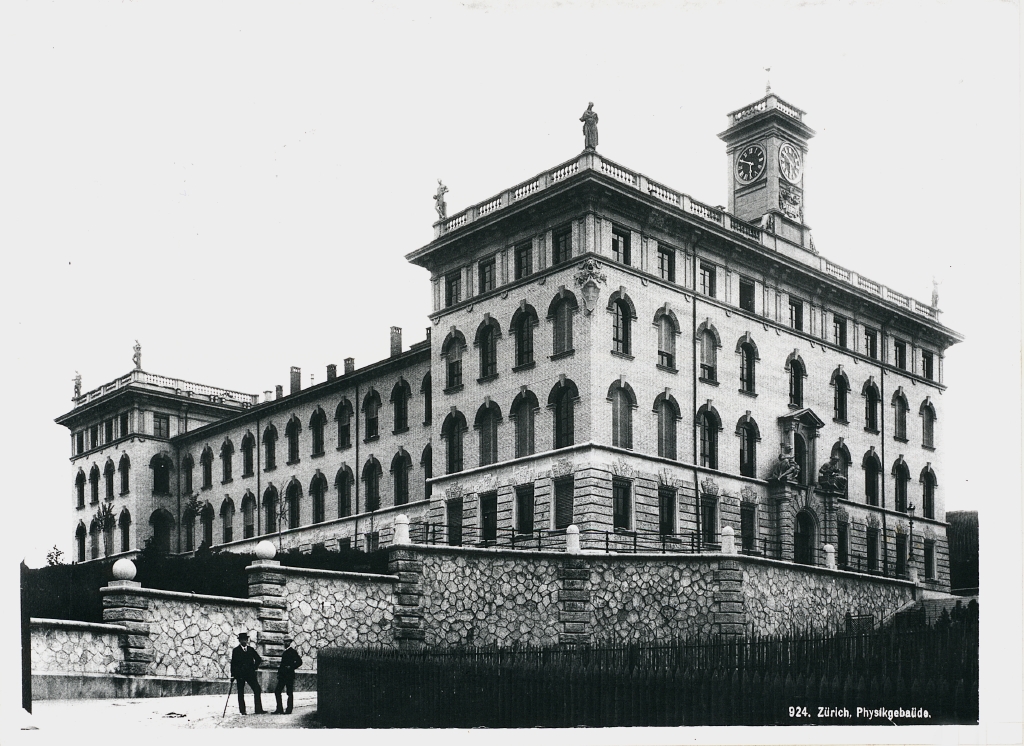
As a student at ETH, still a polytechnic school at that time, Einstein complained about the lack of then modern theoretical physics in the curriculum around 1900. He would eventually change the situation when, in 1912, he accepted a chair for theoretical physics at his alma mater which, by then, had been given the status of a Technical University. His successors, Peter Debye and later Wolfgang Pauli, were responsible for keeping the high standards of this discipline in teaching and research. The filed of experimental physics at ETH was dominated after 1920 by Paul Scherrer, who introduced a strong program in nuclear physics, starting from 1932.
Moving to Hönggerberg
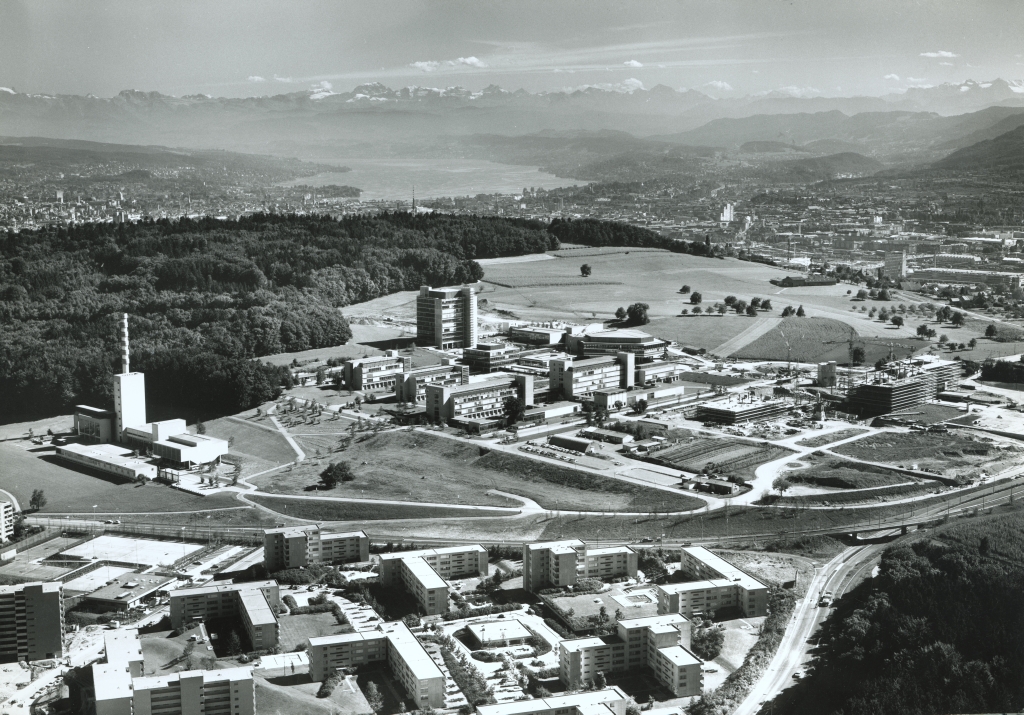
After 1960, the steep increase in the number of students in natural and engineering sciences in general and in physics in particular lead to an unprecedented extension of the physics faculty, particularly in condensed-matter, theoretical and particle physics. The inevitable space problems were solved with a step-by-step development of a new campus on Hönggerberg outside the city centre between 1965 and 1973. At the same time the former Institute of Physics changed its organisational form to that of a Department (D-PHYS), without much change in its general layout until today.
Research in condensed-matter physics on magnetism, superconductivity and ferroelectricity relied on the capability to synthesize and characterize materials, complemented by a significant effort in laser physics and development. The Institute for Particle Physics benefited from CERN programs and participated in the realization of a medium-energy proton accelerator at the national laboratory for nuclear- and particle physics (SIN, now Paul Scherrer Institute).
In theoretical physics, the traditionally strong field of mathematical physics was complemented by chairs in condensed-matter and phenomenological particle physics.
After 1980, the growing importance of research and technology based on the interaction between light and matter motivated the introduction of the new discipline of quantum electronics, both in research and in the educational curriculum. The new institute (IQE) grew rapidly to the size of the other three mentioned above (LFKP, IPP, ITP). Furthermore, the activity in condensed matter physics was expanded into the direction of mesoscopic physics. The tremendous advances in the construction of earth- and space-based observatories and hence the continuously achieved progresses of observational astronomy suggested an extension of the existing program in astronomy, a development that was finally realized with two additional chairs in astronomy just after the beginning of the new millennium. Cooperation with University of Zurich (UZH) exist for the teaching in theoretical physics and the graduate education in particle physics. Since 2000, a number of groups are prominently involved in the new National Priority Research Programs (NCCR).
Ever evolving
Most recently, the undisputed importance of a high-quality education of high-school teachers was demonstrated by the instalment of a new chair for physics education. New links to the Paul Scherrer Institute (PSI), the National Laboratory of Switzerland, were realized via joint chairs. Specifically, the laboratory for neutron scattering LNS at PSI operates jointly under the auspices of the Department of Physics and PSI. The department also hosts the laboratory for ion-beam physics (LIP). The installation provides experimental tools for environmental sciences, climatology, archaeology and materials science.
The latest development in research is a program in quantum science and technology (QSIT) with the participation of various institutes ETH-wide and external groups within Switzerland (Geneva, Basel); excellent technical support is provided by the FIRST lab, a platform for handling artificial micro- and nanostructures. Particle physics and astronomy are both prominently involved in international programs in Europe and overseas; the Planet-Z initiative joins research groups at ETH Zurich and the Universities of Zurich and Bern in a multi-disciplinary research effort in planetary sciences.